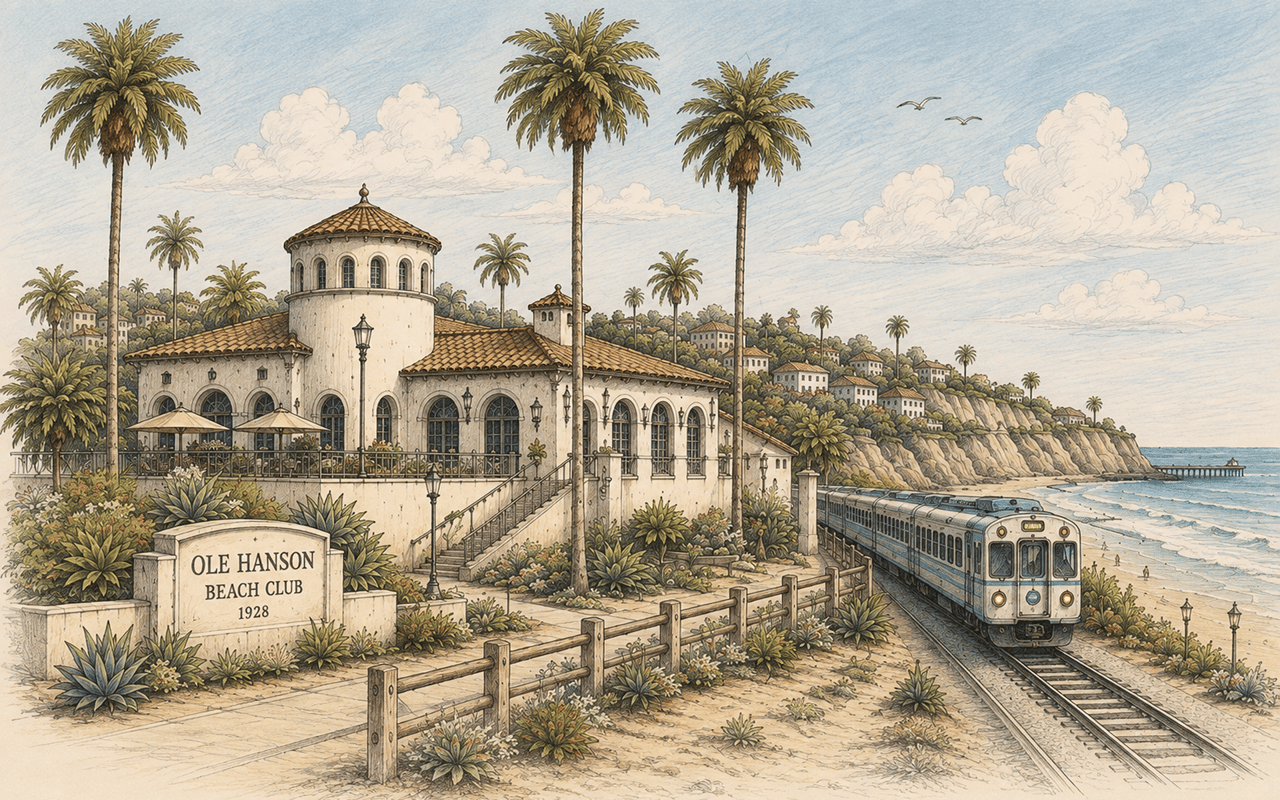
Welcome to
North Beach
Pairs vintage California architecture with rich surf culture in one of San Clemente's oldest communities.
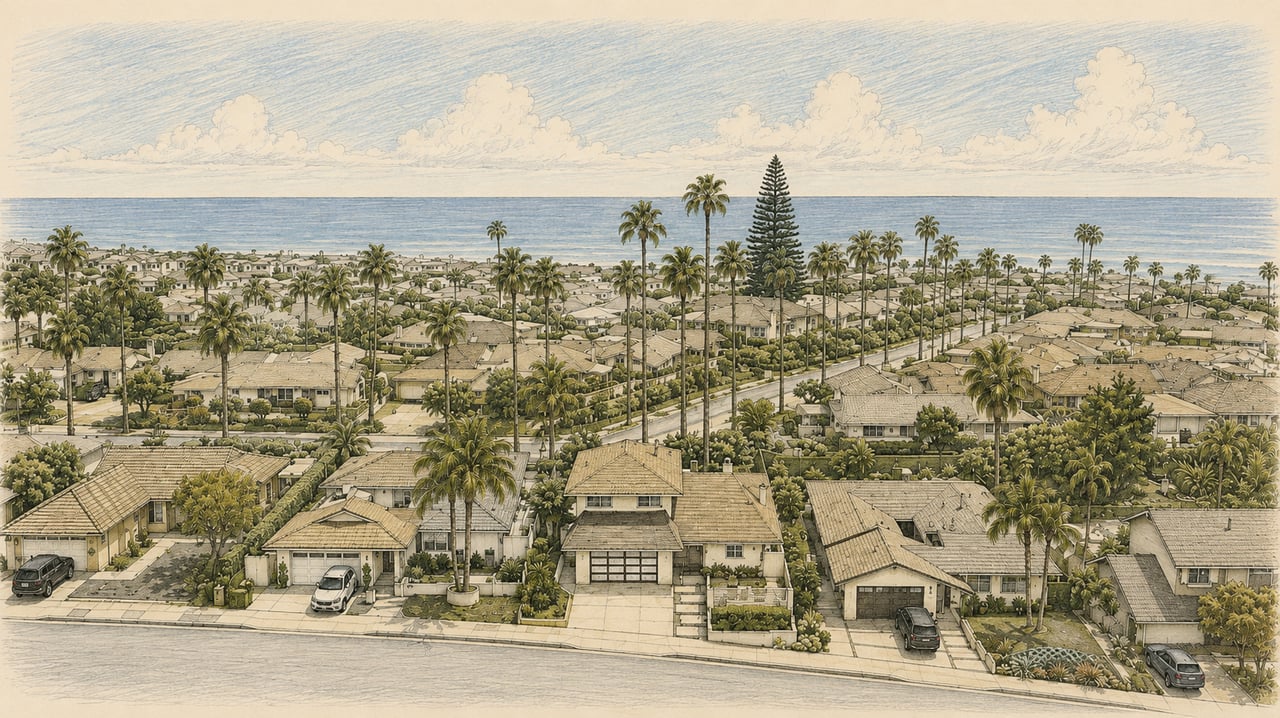
This is where San Clemente’s original history, beach culture, rail corridor, mixed housing, newer infill development and everyday neighborhood life overlap. You can find an older Spanish-style home, a small beach cottage, a single-level bungalow, a condominium, a duplex or multifamily property, a newer luxury residence and an ocean-view home within a relatively tight geographic area. That variety is exactly why I would never describe North Beach as one uniform neighborhood.
For buyers, the most important questions are often not bedroom count and square footage. They are: Which side of El Camino Real are you on? How easy is the actual walk to the sand? What is between the property and the ocean? Where is the rail line relative to the home? How usable is the parking? Is the view from the primary living space or only from one upstairs window? Is the house historically significant? And how much of the value is the property itself versus the location around it?
For sellers, those same distinctions can create meaningful differences in value. A house near North Beach with a functional garage, a usable outdoor area and a broad ocean outlook may compete very differently from a similarly sized home only a few streets away. North Beach rewards property-by-property analysis.
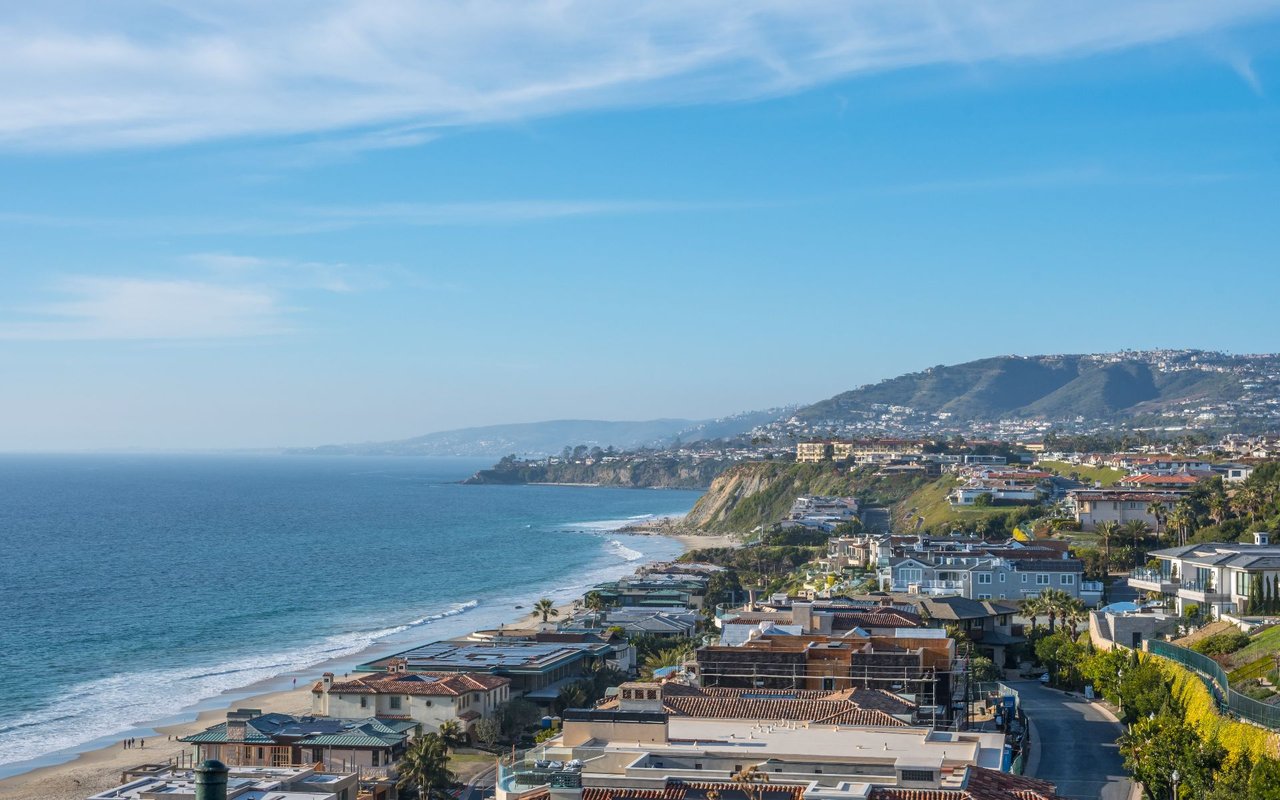
North Beach sits at one of the historic gateways into San Clemente. The area is centered around the coast at Avenida Pico and North El Camino Real, where several of the city’s defining early landmarks were built. The result is a neighborhood that feels older, more eclectic and more urban-coastal than many of San Clemente’s planned residential communities.
Talega is organized around master-planned neighborhoods, pools and trails. Forster Ranch is defined by established inland tracts and mature residential streets. Sea Summit is newer coastal development built around preserved open space. North Beach is different. Its identity comes from a mix of historic architecture, individual homes, multifamily properties, commercial uses, the beach, the railroad, the trail and a small number of streets that have evolved over many decades.
That mixed fabric is part of the appeal. North Beach can feel lived-in rather than designed all at once. It has history without feeling like a museum, beach access without the same atmosphere as the Pier Bowl, and a growing food-and-gathering scene without becoming downtown San Clemente.
If you are still deciding which part of town fits you best, my San Clemente neighborhood guide is the best place to compare North Beach with the rest of the city.
The strongest sense of place in North Beach is concentrated around Avenida Pico, Avenida Estacion and the historic buildings just inland from the sand. This is where the neighborhood stops feeling like a generic stretch of coastal Orange County and starts feeling unmistakably San Clemente.
Ole Hanson’s original vision for San Clemente was not simply a collection of Spanish-style houses. It was a complete coastal town, and North Beach still contains several of the civic and recreational landmarks that help explain that vision. The Ole Hanson Beach Club, Casino San Clemente and the historic Miramar property create a cluster of architecture and public life that is unusual for a neighborhood of this size.
For a homeowner nearby, that history is not abstract. It affects the streetscape, the architecture people expect to see, the way visitors use the area and, in certain cases, how remodeling or redevelopment should be approached. The City’s Architectural Overlay includes North Beach, so I would never assume that a major exterior project should be treated like an ordinary remodel elsewhere in Orange County.
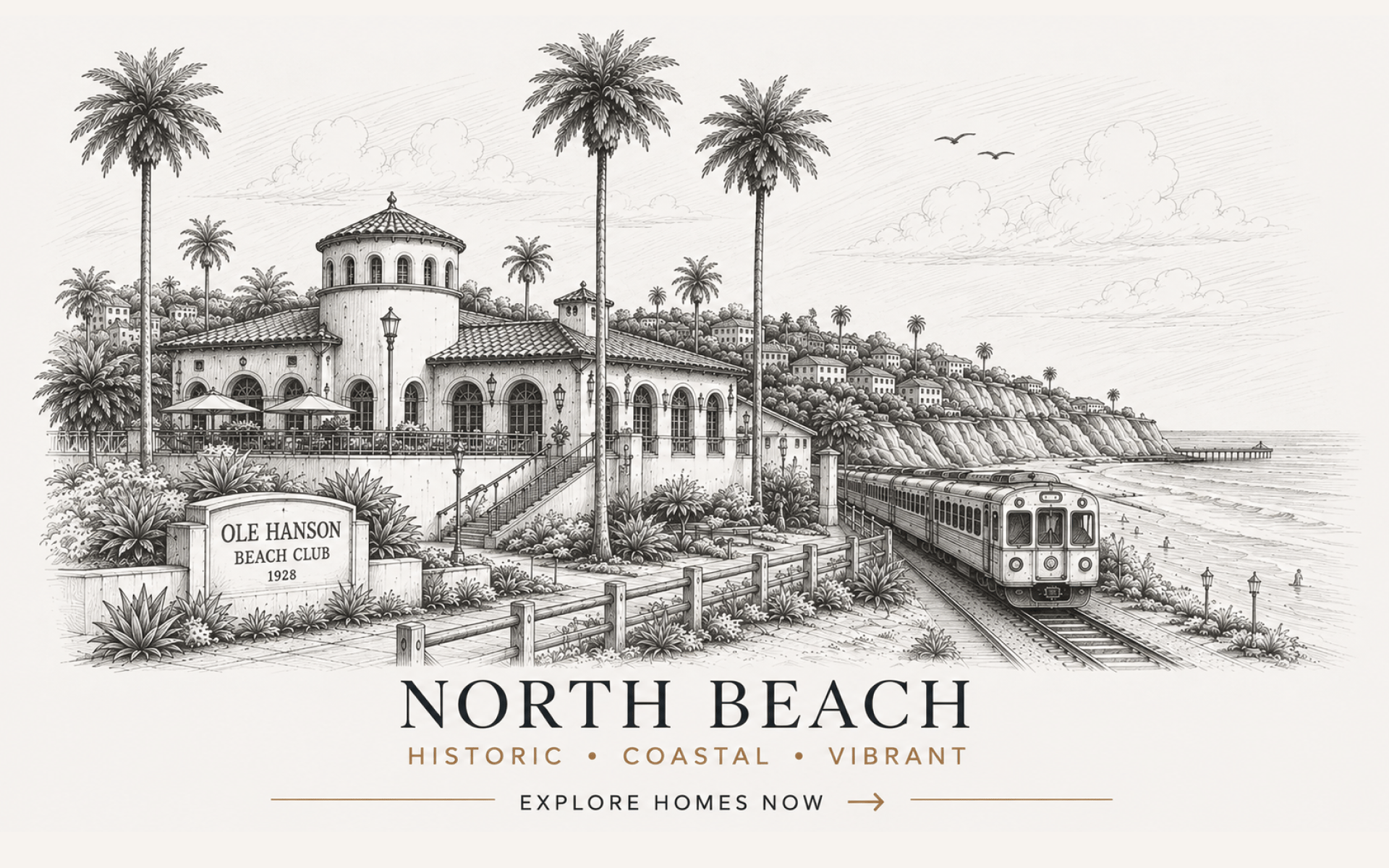
The Ole Hanson Beach Club at 105 West Avenida Pico is one of the defining buildings in North Beach. Built in 1928, the Spanish Revival landmark sits above the beach with a 25-yard lap pool, a smaller wading and lesson pool, locker rooms and event space. The City completed a major renovation and reopened the facility in 2016.
Even if you never use the pool, the Beach Club matters to the real-estate experience around it. It gives this part of North Beach a recognizable civic landmark, a landscaped bluff-top setting and a sense of history that buyers notice immediately. Homes near the Beach Club can feel connected to the original Spanish Village in a way newer neighborhoods simply cannot reproduce.
The practical tradeoff is activity. Weddings, events, swim programs, beach visitors and seasonal traffic can all influence how the immediate area feels at different times. If I were helping you evaluate a home very close to the Beach Club, I would want you to experience the street on more than one day and at more than one time.
Just across the North Beach historic core, Casino San Clemente is another major piece of the neighborhood’s identity. Despite the name, it is not a gambling casino. It is a historic event venue that reflects the early resort character of San Clemente and continues to draw weddings and private events.
That matters because North Beach is not purely residential. Certain streets are influenced by beach use, events, restaurants, rail passengers and visitors in a way that is very different from a quiet cul-de-sac farther inland. Some buyers love that energy. Others want the coast but prefer a more exclusively residential environment. I would rather identify that preference before we fall in love with a house.
The restoration of the historic Miramar Theatre property has changed the feel of North Beach. After years of sitting largely dormant, the landmark has been brought back into active use as Miramar Food Hall, creating a new dining and gathering destination at the northern coastal gateway.
This is important for real estate because neighborhood value is not only about what is inside a house. It is also about what you can walk to and what the surrounding district feels like after you move in. North Beach now has a stronger reason for residents and visitors to stay in the area rather than simply pass through on the way to the beach or train.
I would not try to predict a specific dollar amount that a new restaurant or food hall adds to nearby homes. Real estate does not work that cleanly. But it does change the daily utility of the location. Being able to walk from a residence to the sand, Beach Trail, train, historic landmarks and a growing dining cluster makes North Beach a more complete neighborhood than it was when the Miramar property was inactive.
The San Clemente station at North Beach is one of the neighborhood’s most unusual features. The platform sits at the coast near Avenida Estacion, close enough that stepping off a train immediately feels like arriving at the beach rather than at a conventional suburban station.
For residents who actually use regional rail, that can be a meaningful lifestyle advantage. It creates another transportation option for trips north and south without first driving inland to a station. The City’s seasonal trolley system also uses the North Beach station as a stop, adding another transportation connection during operating periods.
But rail proximity is a property-by-property consideration. I would never tell a buyer that being “near the train” is automatically good or bad. I want to know how the home is oriented, how much of the rail activity you hear from the yard and bedrooms, whether windows have been upgraded, where outdoor living spaces are located and how sensitive the buyer is to intermittent noise.
Two homes can be similar distances from the tracks and feel very different. Buildings, elevation, walls, landscaping and orientation all influence what you experience. This is exactly the kind of detail an online map cannot answer for you.
North Beach is the northern trailhead of the San Clemente Beach Trail. The City identifies the trail as a 2.3-mile coastal route connecting North Beach with Calafia Beach, with the Pier and T-Street along the way.
For someone who likes to walk, run or ride a conventional bicycle, that changes the daily routine. You can leave North Beach and follow the coast south toward the Pier Bowl and beyond without treating the beach as a destination that requires a car every time.
The detail I want buyers to understand is that “near the Beach Trail” does not mean every home has the same access. The rail corridor sits between portions of the neighborhood and the water, and legal crossings matter. A property that looks extremely close to the ocean on an aerial map may have a different actual route to the beach than the distance suggests.
That is why I like to test the route. If you tell me that walking the dog on the trail every morning or carrying a surfboard to the beach is important, I want to walk the route from the house rather than rely on the listing description.
North Beach itself is the northernmost public beach in the City of San Clemente. The public access area includes the station, parking, restrooms and beach facilities, and it connects directly into the Beach Trail system.
Living close to that access can be terrific if beach use is part of your daily life. It can also mean your street experiences more visitors during warm weekends, summer periods and community events. A home with off-street parking and a functional garage can therefore be more valuable in practical terms than the same feature might be in a less visited inland neighborhood.
When I evaluate parking in North Beach, I do not stop at “two-car garage” on the MLS. I want to know whether two modern vehicles actually fit, whether there is driveway parking, how easy the garage is to enter, whether the street fills on busy days and how guests will park. Those details can become part of everyday life very quickly.
Boca de la Playa is one of the streets that best demonstrates why North Beach cannot be valued by neighborhood name alone. It sits immediately in the coastal environment near the Beach Club, beach access, rail corridor and station, with some properties occupying unusually dramatic positions relative to the water.
A home here can have a relationship with the ocean that is fundamentally different from a property only a few blocks inland. But that does not mean every Boca de la Playa property should be valued the same way. View width, elevation, foreground, parking, lot configuration, privacy, renovation quality and exact rail relationship all matter.
If the purchase price reflects an ocean-view premium, I want to see where the view exists in normal life. Is it from the kitchen and living room? The primary bedroom? A deck? Only when standing in one corner? Does a roofline dominate the foreground? Is the view open enough that you feel it when sitting down? Those questions matter more to me than the words “ocean view” in a listing.
Avenida Estacion is the access street most closely associated with the station and North Beach parking. It is not a quiet interior residential street in the conventional sense; its importance is connection. Beach users, trail users and train passengers all interact with this small part of North Beach.
For a buyer, that means the value proposition is highly lifestyle-specific. If your ideal morning is walking to the beach or catching a train without getting in the car, proximity can be a major advantage. If your priority is maximum residential quiet and minimal visitor activity, you may prefer to move a few streets away while keeping North Beach within walking distance.
Avenida Pico is one of San Clemente’s most important east-west roads, and North Beach is where Pico reaches the coast. That makes this intersection a true gateway: beach, rail, historic landmarks and El Camino Real all come together here.
The advantage is access. From the North Beach side, Pico provides a relatively direct connection back toward Interstate 5, Avenida Vista Hermosa, the Outlets at San Clemente and inland neighborhoods. For someone who wants coastal living but travels north frequently, that can be more convenient than living farther south near the Pier or Southwest.
The tradeoff is that Pico is an active corridor. A home immediately influenced by Pico will not feel like a quiet interior street. Traffic, visibility and turning movements can matter. I would evaluate those factors at the times of day the buyer will actually be home, not only during a midday showing.
Calle Las Bolas is one of the North Beach-area streets where old San Clemente and newer construction can sit remarkably close together. Historic resources remain in this part of town, while newer infill residences and substantial remodels have also appeared over time.
That creates a streetscape with more architectural variety than you find in a single-builder tract. For some buyers, that is exactly the appeal. A Spanish-style historic home, a mid-century property and a contemporary residence do not need to look identical for the street to feel cohesive. North Beach has evolved in layers.
It also means comparable sales require judgment. A newly built luxury residence should not automatically be compared with an older property simply because they share a street name. Age, construction quality, parking, lot, view, unit count and historic status can put them in very different buyer categories.
Calle Sacramento and nearby residential streets can give buyers a more neighborhood-oriented version of North Beach. Here you can find smaller single-family homes and beach bungalows that feel removed from the immediate station activity while still being close to the coast.
These are the properties where I pay close attention to the relationship between charm and function. A compact cottage can be wonderful if the lot, parking and indoor-outdoor connection work well. The same square footage can feel much less functional if the parking is awkward, storage is limited or a past addition created a strange floor plan.
Small houses near the coast should not be judged by square footage alone. Location, lot utility and the ability to live comfortably in the space can matter more than an extra few hundred square feet in a weaker position.
As you move inland and slightly south from the immediate beach core toward streets such as Avenida Florencia and Calle Puente, the relationship to North Beach changes. You remain close to the coast, but the setting can become more residential and less tied to the station platform or beach parking lots.
This part of the search can be especially interesting for buyers who want older San Clemente character and coastal access without living directly in the busiest part of the North Beach historic core. Las Palmas Elementary is located on Calle Puente, adding another long-established neighborhood landmark nearby.
The practical lesson is that “North Beach” can mean different things to different agents and listing portals. I care less about whether an online map draws a particular street inside or outside a colored boundary and more about how the address actually lives: the walk to the water, the terrain, parking, traffic pattern, architecture and relationship to the North Beach core.
North El Camino Real is the spine that connects North Beach with downtown and the northern side of San Clemente. Homes and mixed-use properties closer to El Camino have easier access to restaurants, businesses and the historic district, but they also experience a more active street environment.
For some buyers, that is part of the appeal. They would rather walk to coffee, food and the beach than live on a quiet street that requires a drive for everything. Others want the ocean nearby but do not want to hear or see the activity associated with El Camino Real.
This is where I would ask a buyer to be very honest about what “walkable” means to them. Walkability is not automatically superior to quiet. It is a lifestyle choice, and North Beach gives you versions of both within a short distance.
One of the biggest mistakes buyers make in North Beach is assuming the neighborhood is primarily a collection of detached beach houses. The housing mix is much broader.
Depending on the street, you may encounter:
That variety affects everything from financing and HOA dues to parking, rental considerations, insurance, maintenance and comparable sales. A two-bedroom condominium near the station is not competing with the same buyer as a detached ocean-view home near Boca de la Playa, even though both may be marketed as North Beach.
North Beach contains some of San Clemente’s most important historic resources, but I would never assume an older Spanish-looking house is automatically an original Ole Hanson home or a designated historic property.
The City’s historic surveys distinguish among individual resources, potential contributors and designated structures. Those classifications can affect how I would approach due diligence, remodeling expectations and the long-term stewardship of the property.
If you are buying because you love the architecture, I want you to understand what is original, what has been altered, what records exist and whether the property has any formal historic status. If you are buying because you want to dramatically expand or modernize the home, I want to investigate those same questions before you assume the project is straightforward.
For a deeper look at this issue, see my street-by-street guide to Ole Hanson and historic homes in San Clemente.
North Beach has enough older housing that renovation quality deserves serious attention. A new kitchen, wide-plank flooring and fresh paint can make a property look completely updated in photographs, but those improvements do not tell you what is happening behind the walls or below the house.
Depending on the age and construction of the property, I want to understand the roof, plumbing, electrical system, sewer line, drainage, foundation, windows, waterproofing, previous additions and permit history. Near the coast, I also pay attention to exterior metal, railings, gates, fasteners, windows and other materials exposed to salt air and moisture.
The point is not to be afraid of an older home. Some of North Beach’s hardest-to-reproduce locations are occupied by older houses. I simply want the buyer to know whether the charm comes with a well-maintained structure or a long list of deferred work.
I explain that process in more detail in Buying an Older Home in San Clemente: What I Look For Before My Buyers Fall in Love.
North Beach also has newer infill homes and condominium projects that create a very different product from the older beach housing around them. Buyers may get open floor plans, larger windows, contemporary indoor-outdoor design, elevators in some projects, bigger garages and newer building systems while staying within the historic coastal district.
That combination can be compelling because newer coastal housing is limited in San Clemente. But I still evaluate the location just as carefully as the building. A beautiful new residence does not eliminate rail exposure, street activity, parking patterns or the difference between a true ocean view and a partial one.
The newer the property, the more important it can be to understand how much of the purchase price is being driven by construction quality versus scarcity of newer inventory near the coast.
Parking is not a glamorous topic, but it can be one of the most important parts of owning property in North Beach. The neighborhood combines beach visitors, event activity, restaurant customers, rail passengers, multifamily housing and older homes that were not all designed around today’s vehicle sizes.
A truly usable two-car garage can be a meaningful differentiator. So can driveway parking, easy garage access and enough curb space that guests are not constantly circling the block. On a multifamily property, I also want to understand whether each unit has practical parking rather than just technically compliant parking.
This is one of those features buyers often underweight during a showing because the ocean is distracting. Six months later, parking can be part of the daily routine. I would rather value it correctly before you buy.
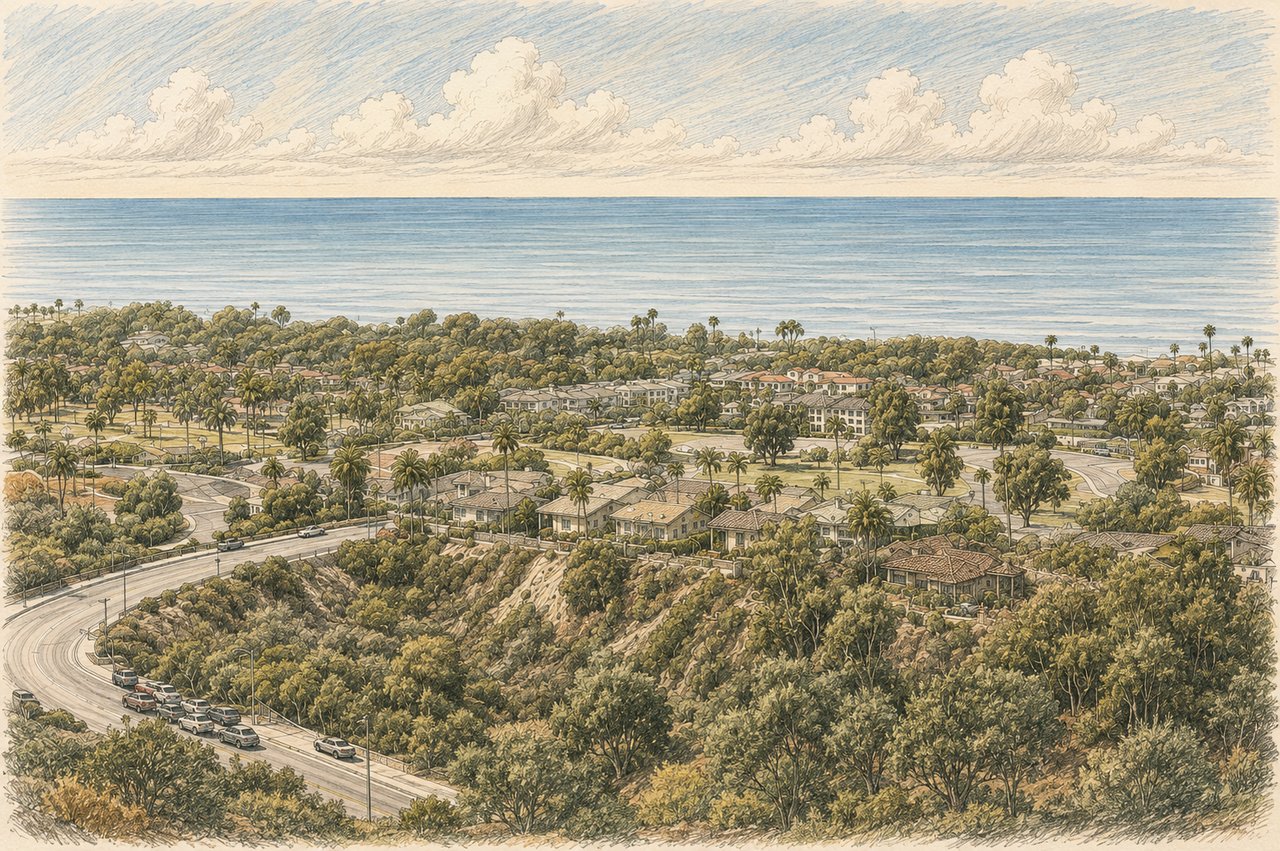
North Beach can offer beautiful ocean and coastline views, but the word “view” is too broad to be useful by itself. The topography, street position and mix of buildings create many different view experiences.
One property may have a broad Pacific outlook with Catalina visible on clear days. Another may see a narrow strip of blue between buildings. One home may have water visible from the primary living spaces and outdoor seating. Another may require walking upstairs and standing beside a window.
I look at four things: width, foreground, orientation and living position. A view across rooftops can still be attractive, but it is different from an open horizon. A west-facing deck may get beautiful sunsets but also stronger afternoon exposure. A view from the sofa usually carries more day-to-day value than a view you only see while standing.
I also want to understand what is legally protected and what is simply open today. I would never tell a buyer that a view is “protected” without a real basis for saying so.
North Beach is directly influenced by the Pacific. Cool mornings, marine layer and ocean air are part of the lifestyle, particularly compared with warmer inland neighborhoods such as Talega.
Some buyers love that. They want to open windows, feel the cooler air and live close enough to the coast that the weather itself feels different. Other buyers prefer more consistent morning sunshine. Neither preference is right or wrong, but it should influence where we search.
Salt air also matters for maintenance. Exterior hardware, railings, gates, window components, light fixtures and other exposed materials can age differently near the water. When I tour a property, I pay attention to how well the exterior has been maintained rather than assuming the coastal setting is purely an aesthetic advantage.
For more on how weather changes across town, see my San Clemente microclimates guide.
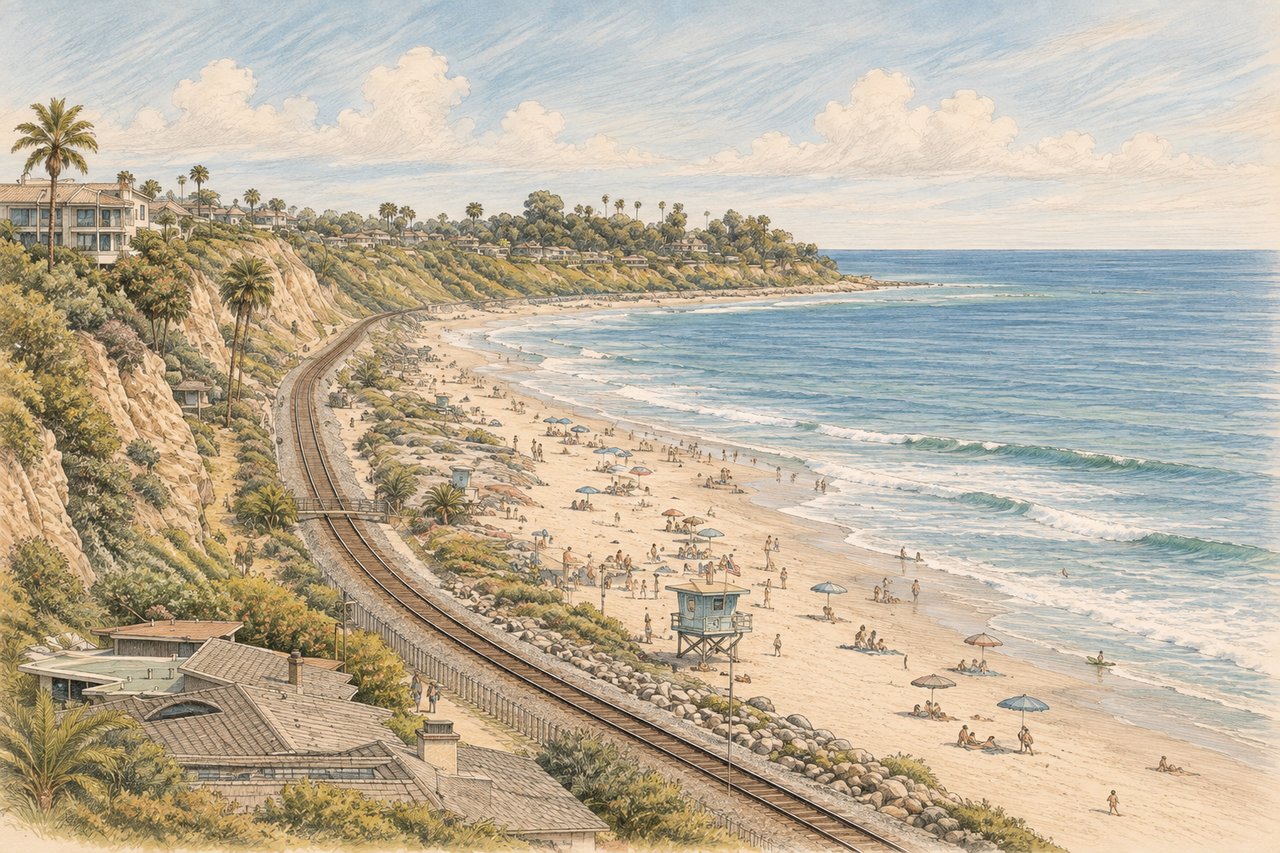
The railroad is physically part of North Beach. It runs along the coast between the neighborhood and portions of the beach environment, and the station sits in the heart of the area.
I do not make assumptions about how a buyer will react to that. Some people barely notice rail activity and love the transportation connection. Others are highly noise-sensitive. What matters is testing the actual property.
I like to stand in the backyard, primary bedroom and main living area. I listen with windows open and closed. I look at whether outdoor entertaining is oriented toward or away from the corridor. I pay attention to walls, elevation and intervening structures. A map gives us distance; the house tells us the experience.
North Beach is one of San Clemente’s more walkable coastal areas, but even here I would not measure lifestyle with a simple radius on a map.
A home can be close to North Beach but sit on a steeper street. Another can be farther in straight-line distance but have a more pleasant route. Crossing El Camino Real, reaching a legal rail crossing, carrying beach equipment and walking home uphill can all change the experience.
If walkability is one of the reasons you are paying a premium, I want to test the exact walk. Go to the beach. Walk to Miramar. Walk to the train. Walk home. Do it in normal shoes, not as an abstract map exercise. That tells you much more than a Walk Score.
North Beach is part of San Clemente’s surf culture, but I would distinguish “living near the ocean” from “living next to the surf break you use most.” North Beach has its own beach and nearby breaks, while a serious surfer focused on T-Street, Lost Winds, Riviera or Trestles may still prefer another part of town.
The advantage here is the overall coastal routine. You are close to the sand, connected to the Beach Trail and positioned on the northern side of the city. The right choice depends on whether you want North Beach itself or whether your surf routine repeatedly takes you south.
For someone who surfs but also commutes north, North Beach can create an interesting compromise: coastal access without living as far south as Southwest or the Trestles side of town.
North Beach has an advantage that does not show up in lifestyle photography: geography. It sits on the northern side of San Clemente, with Avenida Pico providing a relatively direct route to Interstate 5 and the coastal station providing a regional rail option.
If a buyer works in Irvine, Newport Beach or farther north, I want to compare the real commute from North Beach with the same trip from Southwest, Southeast or deeper inland neighborhoods. Ten or fifteen minutes of daily positioning can matter more over several years than it seems during a weekend house hunt.
I would never choose a house based only on commute. But I would never ignore commute either. The right home should work on an ordinary Tuesday morning, not just during a sunset showing.
North Beach is within the Capistrano Unified School District. Las Palmas Elementary, located at 1101 Calle Puente, is a long-established San Clemente school and the city’s original school site, with roots dating to 1927. It operates a two-way Spanish immersion program.
School attendance boundaries and program eligibility can change, and North Beach-area addresses should always be verified individually with Capistrano Unified. I would not rely on a real-estate portal or a neighborhood page to determine enrollment eligibility for a specific property.
Because North Beach includes a mix of single-family, condominium, multifamily and mixed-use properties, buyers sometimes make assumptions about rental possibilities based on what they see next door. I would not do that.
San Clemente regulates short-term lodging and apartment rentals, and zoning can vary by property. A duplex, condominium and detached house on nearby streets may have very different rules, HOA restrictions and permitted uses. If rental income is part of the purchase decision, the address needs to be researched before the numbers are treated as real.
The same principle applies to redevelopment. North Beach has historic resources, architectural-design requirements and a mixed-use context. A property’s potential should be evaluated from its actual zoning, parcel conditions and City records rather than from what another owner appears to have done nearby.
North Beach and Sea Summit sit close enough together that buyers often compare them, but they solve very different problems.
Sea Summit is newer coastal master-planned living. The homes are newer, the community has a more coordinated architectural language, and the experience is organized around preserved open space, trails, parks and association amenities. North Beach is older, more mixed, more historic and more directly intertwined with the train station, beach facilities, commercial uses and the original city fabric.
If you tell me you want newer construction, community amenities and a more consistent residential environment, Sea Summit may make more sense. If you want historic character, mixed architecture, direct North Beach identity and the ability to own something that feels individual rather than tract-built, North Beach may be more interesting.
You can compare the newer coastal alternative in my Marblehead & Sea Summit guide.
Marblehead sits above and inland from the North Beach coastal zone and offers a very different residential experience. Its established gated communities, attached-home enclaves and hillside locations are more conventional neighborhood environments than North Beach’s mixed historic fabric.
A Marblehead buyer may be prioritizing a gated setting, larger detached home, hillside elevation or a particular ocean-view corridor. A North Beach buyer may be prioritizing beach access, walkability, historic architecture, the trail and the ability to live close to the activity of the coast.
The two areas can be only minutes apart but feel much farther apart once you live there.
North Beach and the Pier Bowl both offer strong coastal identity, train access and walkability, but the daily experience is different. The Pier Bowl is more directly tied to the San Clemente Pier, Avenida Del Mar and downtown restaurants. It has a concentrated visitor environment and a very specific hillside bowl topography.
North Beach is more linear and spread around the historic northern gateway. Its anchors are the Beach Club, North Beach itself, the station, the Beach Trail, Miramar and the historic event district. It feels less like downtown and more like its own coastal village pocket.
A buyer who wants to walk to the heart of Avenida Del Mar may prefer Central or the Pier Bowl. A buyer who wants the north-side location, trailhead, historic North Beach setting and easier access toward Pico may prefer North Beach.
North Beach is also very different from Shorecliffs. Shorecliffs is an established residential neighborhood farther north with more conventional single-family streets, mid-century housing, golf-course relationships and, for qualifying properties, the private Shorecliffs Beach Club.
North Beach is more mixed-use, more historic and more walkable around its core. Shorecliffs generally gives you a stronger neighborhood-tract feel. If someone tells me only that they want “north San Clemente near the ocean,” I would show both because the difference becomes obvious very quickly.
The Coast District sits inland and east of Interstate 5, so it trades immediate beach access for larger lots, broader residential streets, more conventional yards and a quieter established hillside setting.
North Beach gives you the opposite side of that decision. You may accept a smaller lot, older housing, more parking complexity or greater neighborhood activity because you want to walk to the ocean and live inside the historic coastal fabric.
If usable yard space and a more traditional residential setting are higher priorities, compare the Coast District guide.
North Beach is one of the areas where price per square foot can be especially misleading. Two properties with similar interior size may appeal to entirely different buyers.
I would look closely at:
A property can be smaller and still be worth more if it has the harder-to-reproduce combination of parking, view, outdoor space and beach access. Another home can be beautifully remodeled but still face a ceiling if the street position or functional limitations are weaker.
For sellers who want to understand how I weigh those differences, my San Clemente home-value guide explains the valuation process I use beyond automated estimates.
If I were buying in North Beach myself, I would spend less time trying to identify the “best block” and more time testing the individual property against the lifestyle I actually wanted.
I would ask:
Those questions make North Beach much easier to understand. They also prevent a buyer from paying a coastal premium for a feature that sounds better in marketing than it feels in real life.
North Beach homes should not be marketed with generic “coastal living” language. The neighborhood has too much specificity for that.
If the property is a true walk-to-beach home, show the route. If it has a broad ocean view, photograph the view from the places buyers will actually live. If the garage is unusually functional for the area, make that clear. If the house has historical character, explain it accurately rather than casually calling every Spanish-style property an Ole Hanson home.
If the advantage is newer construction in an older coastal district, that story matters. If the property is multifamily or offers income potential, the permitted use, parking and configuration need to be explained carefully. If the home has a particularly quiet position despite being near the beach, buyers should understand why.
The goal is not to oversell North Beach. It is to show the buyer exactly what cannot be reproduced somewhere else.
North Beach is in an interesting period because the area is gaining new energy without losing the landmarks that made it important in the first place. The Miramar restoration is the clearest recent example. Newer infill housing has also appeared alongside cottages and historic properties.
That evolution can be a positive for homeowners, but I think the best version of North Beach is one that keeps its identity. The Beach Club, Casino, station, historic architecture and relationship to the coast are not obstacles to becoming something newer. They are the reasons the neighborhood is distinctive enough to attract investment in the first place.
For a buyer, that means you are not just choosing a house. You are choosing a neighborhood that is still evolving. I would want you to understand both the history and the direction of the surrounding district before you decide whether it fits you.
North Beach makes the most sense for buyers who want San Clemente to feel coastal every day, not only on weekends. It is especially interesting if you value the Beach Trail, historic architecture, rail access, walkability, independent homes and a neighborhood that feels less uniform than a newer master-planned community.
It is probably not the first place I would start if your priorities are a large flat backyard, a quiet cul-de-sac, a three-car garage and a consistent tract environment. San Clemente has other neighborhoods that solve those priorities better.
But if your wish list includes walking to the ocean, living near the northern trailhead, being part of an historic coastal district and owning a property with real individuality, North Beach deserves a serious look.
You can also search current inventory on my San Clemente homes-for-sale page and then narrow the search property by property.
North Beach is the compact coastal district around the northern end of San Clemente’s shoreline near Avenida Pico, North El Camino Real, Avenida Estacion and Boca de la Playa. The neighborhood includes the beach, the North Beach train station, Ole Hanson Beach Club, Casino San Clemente, the Miramar historic core and surrounding residential streets. Real-estate map boundaries vary, so I focus on the actual street and property rather than a portal’s colored outline.
No. North Beach is an older mixed coastal district rather than a single master-planned subdivision. It includes historic buildings, detached homes, condos, multifamily properties, newer infill construction, commercial uses, beach facilities and transportation infrastructure. That variety is a major part of its character.
From many North Beach-area properties, yes, but the exact route matters. The rail corridor lies along the coast and legal crossings should be used. Elevation, street grade and whether you are carrying beach equipment can also change how the walk feels. I recommend walking the route from any property you are seriously considering.
Yes. North Beach is the northern starting point of the City’s 2.3-mile Beach Trail, which continues south past the Pier and T-Street to Calafia Beach. Temporary construction or safety closures can occur, so current trail conditions should be checked when that access is important to a purchase.
Yes. The San Clemente station commonly referred to as the North Beach station is located near Avenida Estacion and the beach. Rail access can be a lifestyle benefit, while proximity to the tracks is also something buyers should evaluate for noise and orientation at the specific property.
North Beach has one of the more varied housing mixes in San Clemente. Buyers may find historic Spanish-style homes, beach cottages, mid-century bungalows, detached single-family homes, condos, townhome-style residences, duplexes, triplexes, multifamily buildings, remodeled properties and newer luxury infill construction.
Yes, North Beach contains historic resources tied to San Clemente’s early development, including residential properties and major landmarks. But not every older Spanish-style home is an Ole Hanson home or designated historic resource. I recommend verifying the specific address against City records before relying on that description.
The Ole Hanson Beach Club, Casino San Clemente and the historic Miramar Theatre property are among the most recognizable North Beach landmarks. Together with the station and beach, they help define the neighborhood’s historic coastal identity.
Yes. The restored Miramar Theatre property is now home to Miramar Food Hall, adding a modern dining and gathering destination to the historic North Beach district. Because businesses and operating concepts can change over time, I treat the important real-estate point as the successful reuse of a long-dormant landmark and the added walkable activity it brings to the area.
Parking varies significantly by street and property. The City provides public parking at North Beach, but beach visitors, events, restaurants, rail passengers and multifamily housing can increase demand at busy times. For a home purchase, I place real value on functional off-street parking, a usable garage and an easy driveway.
Some do. View quality ranges from broad Pacific and coastline outlooks to partial or narrow views between buildings. Elevation, orientation, neighboring structures and the room where the view is experienced all matter. I evaluate the actual view rather than simply accepting the listing description.
Noise experience varies by property. Distance is only one factor; elevation, building orientation, windows, landscaping and intervening structures can make two similarly located homes feel different. If rail sound is a concern, I recommend spending time at the property and listening from the primary living and sleeping areas.
Yes. North Beach is north of downtown and the Pier Bowl, with El Camino Real and the Beach Trail providing connections toward central San Clemente. It has its own distinct identity, so I would not treat it as simply another part of downtown.
Sea Summit offers newer master-planned coastal homes, preserved open space, association amenities and a more uniform residential setting. North Beach is older, more historically layered, more mixed in property type and directly tied to the train station, Beach Trail and historic commercial core. They are close geographically but very different real-estate products.
The Pier Bowl is centered around the San Clemente Pier, Avenida Victoria and the hillside streets below downtown. North Beach is centered around Avenida Pico, the northern beach, station, Beach Club, Casino and Miramar area. Both are coastal and walkable, but their topography, landmarks and daily activity are different.
I would focus on the actual beach route, parking, garage usability, rail and road exposure, view quality, property type, historic status, condition of older systems, outdoor space, salt-air maintenance, zoning or HOA restrictions and the real commute pattern. In North Beach, the exact property position matters at least as much as the neighborhood name.
North Beach is one of the best examples of why San Clemente cannot be understood through broad labels alone. It is historic and changing at the same time. It can be walkable and active on one street, then surprisingly residential a few blocks away. It includes some of the city’s earliest architecture and some of its newer coastal infill. It gives residents beach, trail and rail access, while also asking buyers to think carefully about parking, noise, maintenance, historic context and property type.
After working in Orange County real estate since 1989, I have learned that the homes buyers remember are often the ones where the location itself gives the property a personality. North Beach has a lot of those homes.
If you are considering buying or selling in North Beach, I would be happy to help you separate the neighborhood name from the details that actually create value: the street, the view, the parking, the architecture, the beach route, the rail relationship and the way the property fits into this very specific part of San Clemente.
Tom Bertog
Tom Bertog Real Estate | San Clemente, CA
Serving Orange County since 1989
7,030 people live in North Beach, where the median age is 49 and the average individual income is $71,896. Data provided by the U.S. Census Bureau.
Total Population
Median Age
Population Density
Average individual Income
There's plenty to do around North Beach, including shopping, dining, nightlife, parks, and more. Data provided by Walk Score and Yelp.
Explore popular things to do in the area, including Stonehill Produce, Kelly's Croutons, and Green Hills Software.
| Name | Category | Distance | Reviews |
Ratings by
Yelp
|
|---|---|---|---|---|
| Dining | 0.67 miles | 0 reviews | 0/5 stars | |
| Shopping | 0.49 miles | 0 reviews | 0/5 stars | |
| Shopping | 0.67 miles | 0 reviews | 0/5 stars | |
| Active | 0.24 miles | 0 reviews | 0/5 stars | |
| Active | 0.24 miles | 0 reviews | 0/5 stars | |
| Beauty | 0.51 miles | 0 reviews | 0/5 stars | |
| Beauty | 0.67 miles | 1 review | 5/5 stars | |
|
|
||||
|
|
||||
|
|
||||
|
|
||||
|
|
||||
|
|
North Beach has 2,988 households, with an average household size of 2. Data provided by the U.S. Census Bureau. Here’s what the people living in North Beach do for work — and how long it takes them to get there. Data provided by the U.S. Census Bureau. 7,030 people call North Beach home. The population density is 9,426 and the largest age group is Data provided by the U.S. Census Bureau.
Total Population
Population Density Population Density This is the number of people per square mile in a neighborhood.
Median Age
Men vs Women
Population by Age Group
0-9 Years
10-17 Years
18-24 Years
25-64 Years
65-74 Years
75+ Years
Education Level
Total Households
Average Household Size
Average individual Income
Households with Children
With Children:
Without Children:
Blue vs White Collar Workers
Blue Collar:
White Collar:





222 Avenida Del Mar San Clemente, CA 92672
222 Avenida Del Mar San Clemente, CA 92672
